
What a Mast Year in My Garden Taught Me About Midlife Creative Abundance
Let me be honest with you, I don't actually like the planting part of gardening.
I like planning.
I like standing in the yard with a mug of sweetened Earl Grey tea and imagining what it could become.
I like weeding, that satisfying release of pulling something out by the root.
I like the decisiveness of pruning, the lightness and spaciousness it creates.
But the actual planting, the digging holes twice the size of the root ball, clearing roots, and amending soil; the getting-down-on-my-knees and pressing things into the dirt part, I find annoyingly tedious.
Many, if not most, gardening metaphors are written by people who love every part of the process, who find the whole thing meditative, grounding, and deeply satisfying. And I do find it satisfying, eventually. But first I find it overwhelming and laborious. Then, after I’ve been at it for an hour or so it becomes meditative and sensory alivening. And then somewhere in the middle of doing the thing I didn't want to do, I find out something I needed to know.
The Branches I've Been Ignoring
All spring I've been ducking under maple branches hanging low over the backyard sidewalk when I roll my trash and green bin out to the sidewalk every Thursday morning. In the front yard there were some maple branches had grown long and hanging close to the ground. The landscape consultant then visited last fall suggested I call the city to have them trim that particular maple since it’s located in the parking strip and not actually on my property so I had it in my mind that was not something I could take care of myself. For all of last season and again this spring, every time I walked past these heavy overgrown branches, I felt a little flicker of irritation. Just enough to be annoying. Not enough, apparently, to do anything about.
Yesterday, something shifted when I needed to plant right underneath those branches in the front yard. I grabbed my long-handled pruners and cut them to the length I wanted, opened up the space, and let more sun through. The solution was so obvious it was almost embarrassing. I'd been walking around a problem for a couple of months that would have taken ten minutes to solve.
How long do we live with something before we realize we can simply trim it back, cut it down, or compost it completely?
I've been thinking about that question in the context of midlife for the past 24 hours. The things we walk around; the low-level irritations we've normalized so thoroughly that we no longer register them as problems — we just route around them, slightly annoyed, every single day. The relationship dynamic, the story we tell ourselves about what we're capable of, the creative practice we keep meaning to return to, and the life that's been waiting just past the branches we haven't gotten around to cutting.
Sometimes it's not a complex psychological excavation.
Sometimes it's just: “Oh. I could cut that back. That would take ten minutes, and I'd have so much more light and space.”
It's Also a Mast Year
If you're not a gardener, a mast year is when certain trees — oaks, maples, beeches and pines, for example — produce a massive, synchronized excess of seeds. Far more than could ever take root, far more than the animals who eat them can consume.
Yesterday, my front yard was covered in tiny maple and pine seedlings because of this. Hundreds of them, growing absolutely everywhere they're not supposed to be.
Last weekend, while visiting my parents and chatting with my dad at the outdoor table, I noticed they had an overstock of pine sprouts too. I commenced moaning to my dad about it, all the weeding of the tree starts that I needed to do before planting.
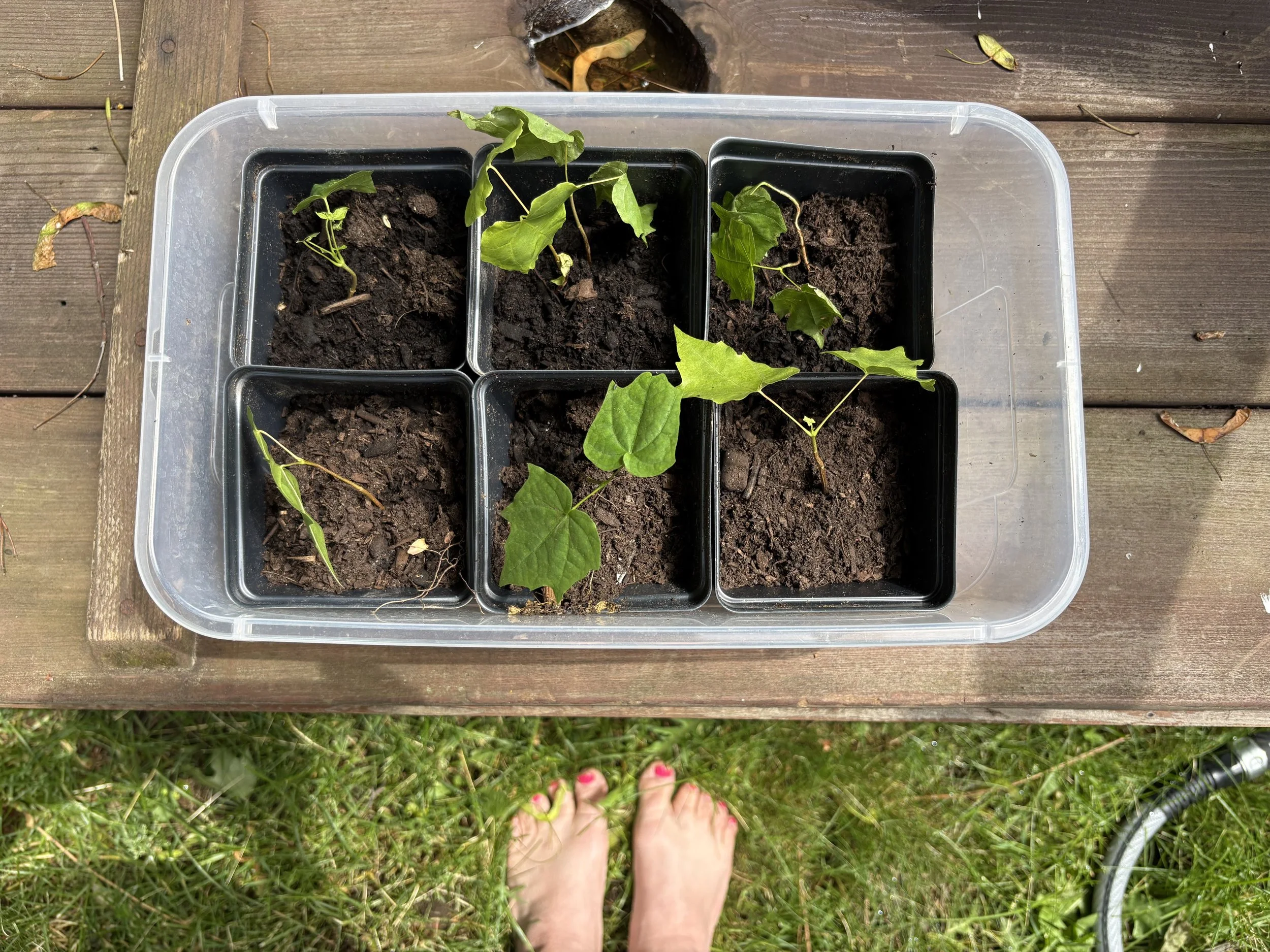
His response was to ask if he could have some, stating he will plant them on their property. The seedlings I was about to pull and throw away are going to become trees somewhere else entirely. After clearing the area of seedlings so that I could plant goldenrod and flowering red currant, I potted up those little baby maples and will happily deliver them to my dad.
Peter Wohlleben, the German forester and author of The Hidden Life of Trees, writes about mast years with reverence. He notes that trees don't bloom every year. I didn’t know that they hold back for three to five years, building energy, waiting for the right conditions. When they finally release, the excess is the whole point. A mother beech tree produces as many as two million seeds in order for just one to survive and become a mature tree. The abundance isn't recklessness; it's strategy. Produce more than can be consumed, and some of it will find purchase somewhere.
The excess isn't waste. It's abundance looking for the right container. What a lesson, what a shift in perspective to reframe my weeding woes into natures abundance happening right outside my window!
My Mom's Rhubarb Plant
My mom and dad tended the property where I grew up for over forty years. It was gorgeous. By the time they downsized to a different house and location two years ago the lawns and wild lands were absolutely gorgeous - full, luscious, productive and fruitful. Again, I found myself bemoaning the fact that my yard was not as I’d dreamed yet. She reminded me that it took nearly 40 years to nurture that property into what I was drooling over.
The place they moved to came together much more quickly. Last weekend my mom told me this current spot is even more beautiful than the one she worked on for decades. She moved a rhubarb plant from her old garden — a huge one, one she'd been tending for years — and it's bigger now than it ever was before.
I've been thinking about that rhubarb plant ever since.
She didn't start over. She brought everything she knew with her. The forty years of tending, of learning what grows and what doesn't, of patience and pruning and knowing when to cut something back — all of it came with her to new soil. And in that new soil, with all that accumulated knowing, things grew faster and more beautifully than they ever had.
Wohlleben would recognize this. The wisdom in the seed, the knowing that travels.
That's what I keep returning to when I think about midlife and creativity and the abundance of this season. Our children grow up and leave, divorce or spousal loss shifts the trajectory of our later years, retirement brings a loss of structure, menopause throws off our stability; all of these transitions can leave women feeling as if they need to start over. The women who come through it most fully alive are not the ones who waited until everything was settled. They're the ones who recognized what they were carrying — all that accumulated knowing, all those years of tending — and put it in new soil while there is still time to watch it grow.
Some of what's coming up right now is weeds. Pull them. Some of it is seedlings that belong to someone else — ideas or obligations that were never really yours to tend. Pot them up and pass them along. And some of it — the parts that have waited the longest, the parts that are most distinctly yours — those are the ones worth planting somewhere they can actually root.
What Midlife Has to Do With Any of This
I'm in my late forties. Midlife, by most definitions, though it still catches me off guard when I say it out loud.
I have more wisdom than I did in my twenties and thirties, that much is clear. I know myself in ways I simply didn't before. I know what I need, what I won't tolerate, what lights me up and what quietly depletes me. There's a groundedness available to me now that wasn't there before, even on the days when the ground itself feels like it's shifting.
Midlife, I'm learning, is not a destination or a crisis. It is a phase, a chapter. One with its own pace and its own specific kind of abundance, if you know how to look for it. The cultural story about this time is mostly about loss and disruption — things falling apart, things no longer working, things you have to grieve or adjust to or survive. And those things are real. But underneath all of that, something else is happening. Decades of accumulated experience, creativity, wisdom, and desire are looking for somewhere to go.
Wohlleben writes that trees pass wisdom down to the next generation through their seeds — that the seed carries something of the tree that made it, encoded and waiting. I think about that when I think about what midlife is actually producing in a woman who has been paying attention. All those years of learning what grows and what doesn't. All that accumulated knowing, encoded and ready, looking for new soil.
The ideas that got shelved during the years of building a career, raising children, holding everything together — they don't disappear. They go underground and keep growing. Midlife is often the season they start pushing back up through the surface.
Not all women let them. Some spend this entire season managing the disruption, treating every seedling like a weed, waiting for things to settle down before they let themselves want something. Waiting for the right time, the right conditions, the finished yard.
The yard is never finished. That's not how yards work. That's not how lives work either.
What I'm Still Learning
I'm learning, slowly and with some resistance, that tending is not the same as controlling. The yard doesn't need me to have a perfect plan. It needs me to show up, notice what's actually in front of me, make a decision about the maple branches instead of walking past them for another three months, and trust that what I'm planting now will grow into something I can't fully see yet.
On my walks through the neighborhood I stop to admire the full, lush yards that took years to become what they are now. I feel both the longing and the patience that midlife is slowly teaching me to hold at the same time.
Every one of those yards started exactly like mine. Full of potential, full of weeds, full of things growing in the wrong direction that someone had to decide whether to cut back or let run.
My mom moved her rhubarb to new soil and it grew bigger than it ever had. She brought forty years of knowing with her, and that knowing was the thing that mattered most.
That's available to all of us. Right now, in this season, in the middle of the mess and the mast year and the maple branches that needed cutting all spring.
If you're in your own kind of mast year — too many ideas, too many possibilities, not sure what to tend and what to let go — The Writing Cocoon opens this fall. It's a weekly online writing group for women in exactly this season.