Feeling Alone in the Developmental Stage Nobody Told You About
You know that feeling when you just want to cancel everything, stay home, and work on your creative projects in complete solitude? When social obligations feel like sandpaper on your nervous system? When you're craving deep, undisturbed time to just be with your thoughts, your hands, your inner world?
That's not laziness. That's not depression (though it can coexist with it). That's not you "failing" at midlife.
That's cocoon time. And it's developmentally necessary.
What Is Cocoon Time?
Cocoon time is a liminal developmental stage—typically happening in midlife—where you need to withdraw from external demands and expectations to undergo a fundamental reorganization of self. Just like a caterpillar doesn't become a butterfly by "working harder" or "staying productive," you can't transform while maintaining all your previous commitments and roles.
Inside the cocoon, the caterpillar literally dissolves into cellular soup before reorganizing into something with wings. It's messy. It's vulnerable. It requires protection from the outside world. And it absolutely cannot be rushed.
For women in midlife—especially neurodivergent women—cocoon time often coincides with:
Perimenopause (hormonal shifts that unmask ADHD and change everything)
Late-life ADHD diagnoses (suddenly understanding your entire life through a new lens)
Empty nest transitions (your primary role shifting dramatically)
Grief or loss (relationships, careers, identities, parents)
Chronic illness or health changes
Spiritual awakening or questioning
The dawning realization that you've been performing "normal" for decades and you're exhausted
Why Women in Midlife NEED Cocoon Time
1. You're integrating decades of experience
By midlife, you've accumulated an enormous amount of life experience, wisdom, and self-knowledge. But you've probably never had the spaciousness to actually integrate it all. Cocoon time gives you the protected space to weave together all those threads—childhood dreams, abandoned creative practices, hard-won lessons, suppressed parts of yourself—into a coherent whole.
2. Your nervous system is demanding it
Perimenopause and midlife hit the nervous system hard, especially for neurodivergent women. The hormonal changes that unmask ADHD also reduce your capacity for stress, social performance, and sensory overwhelm. Your body is literally telling you: "We cannot maintain this pace anymore. We need to go inward."
This isn't weakness. It's wisdom.
3. You're grieving who you thought you'd be
Midlife brings the stark realization that some doors have closed. Some dreams won't come true in the way you imagined. Some versions of yourself need to be mourned. Cocoon time provides the private, protected space to do this grief work without having to perform "I'm fine" for everyone around you.
4. You're remembering who you actually are
All those years of masking, performing, people-pleasing, and trying to fit into boxes that were never designed for you? Cocoon time is when you finally get to shed that exoskeleton and reconnect with your authentic self—often by returning to childhood loves, creative practices you abandoned, and ways of being that feel like coming home.
5. Transformation requires withdrawal
You cannot become someone new while maintaining all your old patterns, relationships, and obligations. Just like the caterpillar needs the protection of the cocoon to dissolve and reorganize, you need protected time and space to undergo your own metamorphosis. This means saying no. This means disappointing people. This means prioritizing your inner work over external productivity.
What Cocoon Time Actually Looks Like
Cocoon time is NOT:
A vacation (you'll still be doing deep internal work)
Permanent (it's a developmental stage, not a lifestyle)
The same as depression (though they can coexist)
Selfishness (it's necessary developmental work)
Cocoon time IS:
Extended periods of solitude and minimal social demands
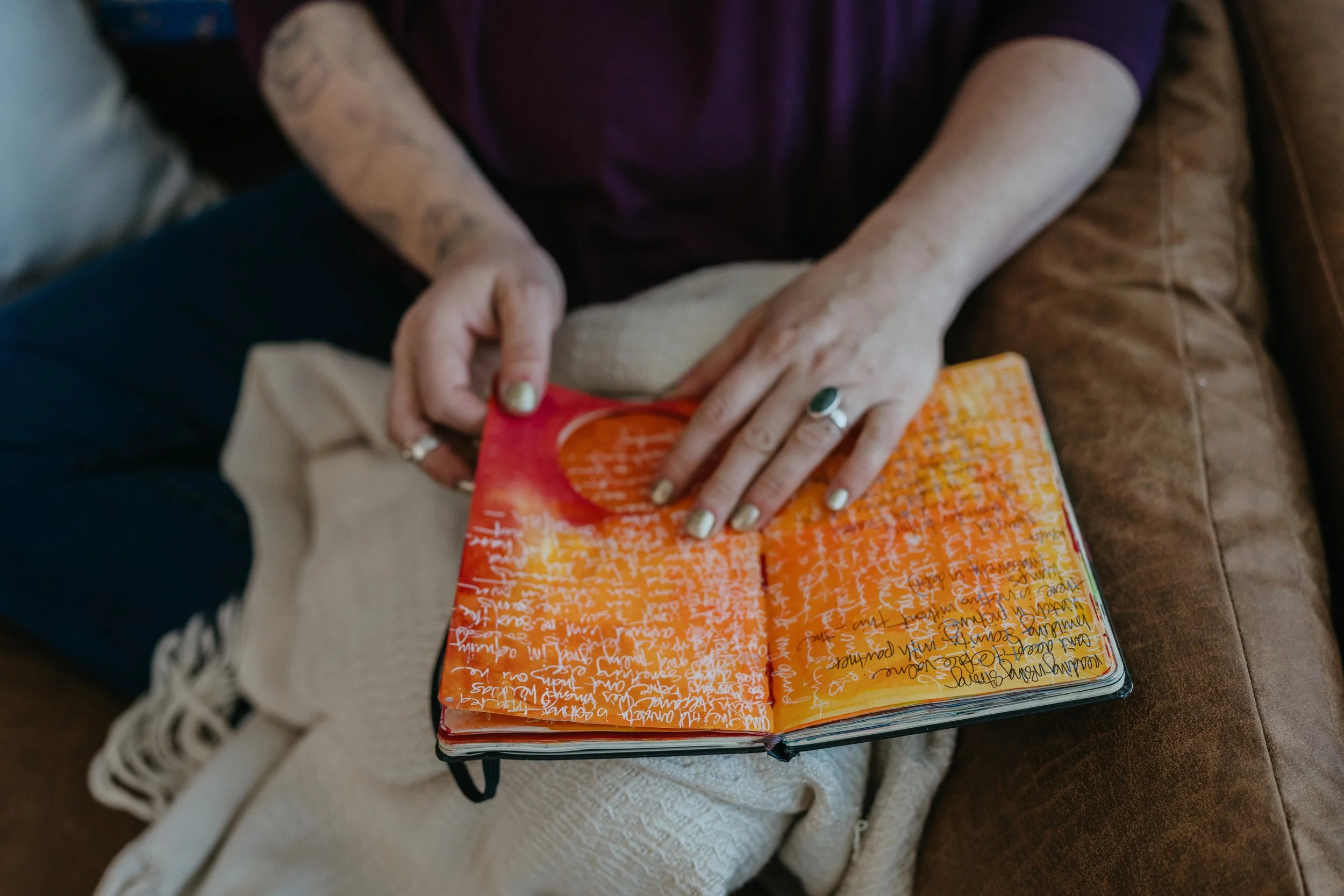
Deep engagement with creative practices (knitting, writing, weaving, gardening)
Lots of time in your body (walking, stretching, resting)
Reading, thinking, processing, integrating
Feeling "unproductive" by conventional standards
Sometimes messy, uncomfortable, or disorienting
Absolutely necessary for what comes next
The Problem: We Don't Honor It
Our culture has no container for women's cocoon time. We're supposed to:
Keep working full-time
Maintain all relationships and social obligations
Stay perpetually available and responsive
Remain productive and useful
Not "burden" anyone with our needs
Emerge from major life transitions without missing a beat
This is impossible. And it's making us sick.
When women try to undergo transformation while maintaining all their external obligations, they often end up with:
Chronic illness or autoimmune conditions
Burnout and exhaustion
Anxiety and depression
Broken relationships (because they're trying to connect from an empty well)
Creative paralysis (no space for what wants to emerge)
The Paradox: You Need Solitude AND Witnesses
Here's what makes cocoon time so complicated: you need protected space to withdraw and do your inner work, but you also can't do this transformation in complete isolation.
You need witnesses who understand what you're going through.
This is especially true when it comes to writing through your transformation. You have things to say—about perimenopause, about unmasking your neurodivergence, about who you're becoming, about what you're grieving and what you're discovering. You journal alone. You think about writing. It stays stuck in your head or scattered across notebooks.
But here's what I see happen over and over again: women in cocoon time need a container that honors both their need for withdrawal AND their need for witnessed transformation.
You can't process these massive life transitions alone. Journaling by yourself isn't enough anymore. You need witnesses who can hold the complexity without trying to fix you, rush you, or turn your messy emergence into a productivity project.
But most writing groups or creative spaces won't work for you right now because they're designed for a different developmental stage. They assume you're ready to produce, polish, and present. They operate with timelines and expectations that feel violent to your nervous system when you're in the middle of dissolving into cellular soup.
What you actually need is a space that understands cocoon time is sacred.
You need:
A container that holds you without demanding performance
Witnesses who understand transformation isn't linear
Structure that actually works with your neurodivergent nervous system instead of against it
Permission to write what's messy, unfinished, and still emerging
Community that honors depth over productivity
You need a place where writing isn't about getting published or being "good enough"—it's about getting what's inside you OUT, so it can transform from stuck thoughts into something with wings.
How to Honor Your Cocoon Time
1. Name it
Stop calling it laziness, depression, or failure. You're in cocoon time. This is a legitimate developmental stage. You're doing important work even when it looks like "nothing."
2. Protect it fiercely
Say no to non-essential obligations. Reduce social commitments. Clear your calendar as much as possible. You need actual spaciousness, not just "me time" squeezed between everything else.
3. Trust the process
You don't know what you're becoming yet. That's the point. The caterpillar doesn't plan its butterfly form—it trusts the biological imperative to dissolve and reorganize. You can trust yours too.
4. Engage in slow, meditative practices
Cocoon time needs embodied, repetitive, soothing activities: knitting, gardening, walking, cooking, journaling, weaving. Your hands need to be busy so your mind can wander and integrate.
5. Find the right kind of companionship
Not all community works during cocoon time. You need people who won't rush you, fix you, or pathologize your need for withdrawal. You need witnesses who understand that your transformation is sacred work, not a problem to solve.
6. Write through it—with the right container
Writing is one of the most powerful tools for integration during cocoon time. But you can't do it alone, and you can't do it in spaces that demand polish and productivity. You need a space that honors writing as spiritual practice, that understands your neurodivergent nervous system needs different conditions to create, that gives you structure without pressure.
7. Know it's temporary
You will emerge. You will have wings. But only if you honor the time in the cocoon instead of trying to force yourself out prematurely because the world is impatient with your transformation.
The Gift on the Other Side
Here's what I know from my own cocoon time and from the women I work with:
When you honor this developmental stage—when you give yourself the protected space to dissolve and reorganize, when you write through it with the right witnesses—you emerge with:
Clearer boundaries and sense of self
Reconnection to your authentic creative expression
Deeper trust in your own wisdom
Less tolerance for bullshit
More capacity for joy
A life that actually fits who you are instead of who you thought you should be
But you have to go all the way through the cocoon.
You can't skip it. You can't rush it. And you definitely can't do it while maintaining your pre-cocoon level of productivity and external obligations.
Your Permission Slip
If you're reading this and recognizing yourself—if you've been feeling the pull to withdraw, to simplify, to stop performing and start integrating—this is your permission slip:
You're not broken. You're in cocoon time.
Honor it. Protect it. Trust it.
And if you need witnesses for the journey—if you need a container that understands both your need for protected space AND your need to get what's inside you out onto the page—know that such spaces exist.
The world can wait. Your wings cannot.
If you're in cocoon time and need the right kind of companionship for your transformation, I created The Writing Cocoon specifically for this—a weekly online writing sanctuary where neurodivergent women in midlife gather to write through our transitions with witnesses who understand that emergence can't be rushed. [Learn more about The Writing Cocoon here.]
Your cocoon time could be calling for one-on-one witnessing. If that feels like the more appropriate fit, [learn more about working with me individually.]