
Why Your Writing Funk Might Actually Be Grief - And What to Do With That
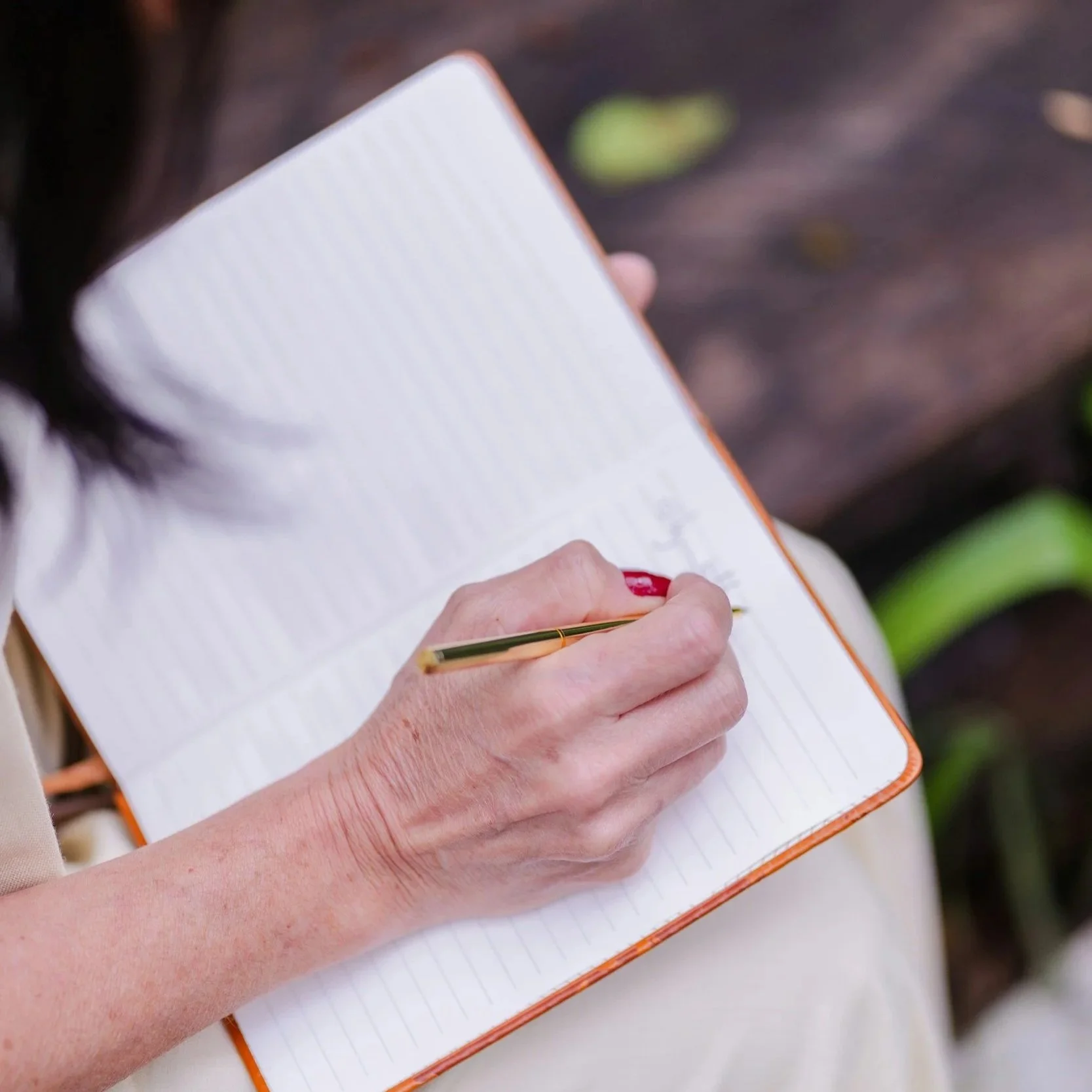
Familiar chair at the window. Favorite gel pen and silky pages in the Moleskine notebook. Intention present, writing prompt at the ready. All the conditions are met.
And then the words don’t come; blank screen, blank page. Just a gray flatness where something used to be.
You close the notebook and tell yourself you’ll try again tomorrow.
If this has been going on for a while, you’ve probably named it a writing funk. I know I have, and so has my weekly writing friend. You may have also told yourself it’s laziness, or that you’re just not a real writer, or that discipline is the missing ingredient, or, like me, perhaps you’re thinking the writing bug has flown off to bite someone else. Those explanations feel logical. They also put the problem entirely on you, which means you’ve been trying to fix something with effort that effort can’t touch.
What if the funk is grief?
When the Tools (ie: conditions) Stop Working
Something I’ve noticed in my work with clients, and in my own life is when something doesn’t resolve after you’ve examined it from every angle, reframed it, journaled it, talked it through, and applied every tool you know, and it still doesn’t lift, it’s usually grief.
Grief is not a coping problem. It can’t be thought away or routined into submission.
It has to be felt.
It has to move through.
The women I work with are self-aware, often deeply versed in their own inner landscape. They’ve done the therapy, the journaling, the personal development. They have frameworks for understanding themselves that took years to build. And yet something still feels unresolved, heavy, like a door they keep approaching but can’t quite open.
That heaviness is grief dressed up in the costume of a problem to be solved.
The Grief That Has No Name
Having no clear loss event is what makes this particular grief so difficult to take seriously. Nobody died. Nothing was taken in one identifiable moment. There’s no date to point to, no before-and-after, no socially recognized thing to mourn. So there are no casseroles. No permission to fall apart. Not even a word for it most of the time, because what exactly did you lose?
Researcher Pauline Boss calls this ambiguous loss and defines it as grief that lacks the clarity of a concrete ending. It’s harder to process than a named, witnessed loss precisely because there’s no cultural script for it. Nobody validates it, and no one asks how you’re holding up, so it doesn’t get the attention it deserves. It goes underground and surfaces instead as flatness, as a writing funk, as the low-grade ache of reaching for something you can’t quite locate.
I’m in the middle of this myself. Less than 2 months before my only child graduates from high school. And less than 5 months before he moves halfway across the country for college. I couldn’t be prouder and more confident in him; the main feeling I’m aware of is excitement at this time. And yet, I feel listless, uninspired; blank pages after years of prolific writing, particularly about motherhood and adventures with my son. I am aware I could be feeling sad, but the sadness doesn’t live on the surface or as a lump in my throat. This change is going to be a loss for sure, but right now it’s a warbly moving target, and airy heaviness that I can’t quite grasp. Pauline was right, it’s ambiguous.
Ambiguous loss is still loss. And it still needs to be grieved.
Where This Grief Actually Comes From
For midlife women, navigating what I can only describe as the slow earthquake of identity shift, this grief tends to arrive in layers. You may be carrying more than one of these at once.
There is grief for a self she never fully got to be. For late-diagnosed women especially, understanding your own brain later in life means reckoning with what might have been different. The creative path not taken because you didn’t know you needed a different kind of container for your work. The years spent calling yourself undisciplined or scattered when you were wired differently all along. That’s grief for a counterfactual life, which is one of the loneliest things to sit with because there’s no one to hold it with you.
There is grief for the decades of white-knuckling it. The hyper-responsible, holds-it-all-together woman was real. She worked hard, she built something, and then perimenopause, or the diagnosis, or midlife itself pulled the floor out from under the strategies that kept her upright. She’s grieving the version of competence she built out of sheer will because nobody told her there was another way.
There is grief for the roles that are loosening. As children grow up and leave, as careers shift, as bodies change, the external structure that told her who she was begins to fall away. Even when those changes are wanted, even when they are right, they are still a kind of loss. The self built around being needed is being asked to become something else, and she doesn’t know yet what that is.
And underneath all of it, there is grief for creativity itself. The feeling of being someone who makes things from the raw material of life. The aliveness of expressing what is felt inside. The relationship she had with her own imagination before she set it aside to be responsible sometimes left decades in the past. She’s missing a version of herself she loved.
The Creative Self Didn’t Just Drift Away
We tend to talk about this as a loss of creativity, as if it wandered off and might wander back. There are feelings about that - feelings from then, when it was happening, and feelings from now, as you stand in the strange place of trying to remember who you were before all the roles claimed you.
When my son was born, my creative life shifted in a huge way. There was no longer space - literally - for all my supplies and tools. There was no longer time to spend a weekend sewing, a day weaving, or hours knitting. There was never support to be creatively expressive from my son’s father.
I was no longer making things, I was caring for the most profound thing I’d ever made, and yet there was grief.
Grief with a story has somewhere to go. A productivity problem doesn’t.
Why the Journal Isn’t Enough
Louise DeSalvo, in her book Writing as a Way of Healing, makes an observation I’ve watched play out over and over in my own work. Writing that heals requires holding both the event and the feelings about it. Feelings from then, when it occurred, and feelings from now, as the person you’ve become since.
Most of us are only doing half. Some write the event, the timeline, and the facts of what happened in their lives. It stays intellectual, narrated from a safe distance. Others write only the feeling, the shapeless I don’t know who I am anymore, without anchoring it to anything specific, so the feeling circulates without moving anywhere. It comes back tomorrow wearing the same clothes.
Holding both, the specific story and the full feeling of it then and now, is what allows something to actually shift. That kind of writing is genuinely hard to do alone. When you’re sitting by yourself with the page, you’re doing two things simultaneously - going into difficult material and holding the space for yourself at the same time. That’s a lot to ask of one person, and your nervous system knows it.
The Funk Is a Signal
When you sit down to write, and nothing comes, your nervous system may be doing something wise. It may be refusing to go somewhere that feels too heavy to carry alone onto the page. The blankness is worth taking seriously as information rather than evidence of failure.
Your whole self might be saying: not like this, not alone, not without someone to hold this with me.
For neurodivergent women especially, standard writing spaces make this worse. The pressure to produce polished work. The rigid structures that work against how our brains actually move. The implicit message that creativity is output. These environments ask you to perform the very thing you’re grieving the loss of - of course, the words don’t come.
Ambiguous grief needs a witness. It needs a container that can hold complexity without rushing toward resolution, and other people who understand that what’s happening at this midlife threshold is a genuine unraveling. That unraveling, done with the right support, is actually the beginning of something.
The Writing Cocoon
The Writing Cocoon is a small, online weekly writing group for women navigating midlife, women who have things to say about who they’re becoming but need a container that can hold the complexity of saying it. We write together in real time. We witness each other without critique. We make room for the grief and the story and the feelings that belong to both.
This is a place to bring the messy truth and let it breathe. The waitlist** is open. Come as you are, funk and all.
Speaking of funk, this song has been in my head all throughout writing this piece. Go have a listen if you need a little encouragement to try out the writing prompt below!
A Writing Prompt to Start Here
If you want to try holding both halves before you join us, here’s a place to begin:
Write about a specific moment when you set your creative self aside. One moment, not the whole story. Maybe it was small. Maybe you barely noticed it then. Describe what happened as plainly as you can. Then write what you felt about it at the time, even if you didn’t have words for it then. Then write what you feel about it now.
Let the three layers sit together on the page. Don’t resolve it. Don’t reach for a lesson. Just see what’s there.
**Waitlist!?
How unfair, Maggie! You spoke to my heart all the way here, and now you’re going to make me wait??
I know, I’d be annoyed too.
I’m in the middle of my own unfolding, my own funk, and writing my way through. Come fall, I will be ready to welcome you into this space.
In the meantime, we can still work together individually, no matter where you are in the world. You can learn more about that here.