How to Harness ADHD Hyperfocus for Creative Breakthrough
My creative practice has always been like a psychological ride on Space Mountain rollercoaster at Disneyland. You speed through the dark, can't see the next drop coming, and you're never quite sure if you're about to launch into hyperfocus heaven or crash into a wall of executive dysfunction. I'm used to it now. I don't beat myself up anymore for the long stretches where my art supplies gather dust, or when I disappear into a creative binge that eats an entire weekend.
But here's what took me way too long to understand: I was experiencing creative seasons. And once I learned to read the cycles, those intense surges and dead zones stopped feeling like chaos I needed to fix. They were just the rhythm. My rhythm.
The Blanket and the Blocks
On my living room coffee table sits a clear plastic box containing needles, dark blue linen squares, white thread, tiny scissors, and a short ruler. Inside are maybe 12 completed, simple embroidered squares.
My son, my only child, is a senior in high school. He'll graduate in June and leave for college in the fall, and I'll be staring down an empty nest. The plan was beautiful in its simplicity: embroider one small quilt block per day, repetitive stitches creating meditative patterns while I process his launch and my own transformation. The stitched blocks would then be sewn into a large quilt and gifted to him when he leaves home.
I researched the best fabrics and threads for this traditional Japanese stitching technique. I purchased yards of dark blue linen; washed it, pressed it, cut out well over 365 perfect 4.5" squares, and stacked them in a nice gift box. I set up my portable stitching kit so I could work anywhere.
How difficult could it be to commit to stitching one little square per day?
Turns out? Really difficult.
My ADHD brain dove in full force during the research, the purchasing, and the preparation. Then the surge ended. And I've been trying to force myself into a daily practice that my brain simply will not cooperate with.
Almost eighteen years ago, I embarked on a similar project.
I was eight months pregnant, wearing a short pale pink cotton robe that barely closed around my swollen belly, sitting on a boxy couch in a cabin in Estes Park, Colorado. I was knitting the final row of a sage green stripe in an organic cotton blanket for my soon-to-be-born child.
There was so much I didn’t know. I didn't yet know I was going to have a son. I didn't yet know that his dad and I would barely make it past his first birthday before we parted ways. I didn't know I'd only give birth to and parent one child, that the door would close on having a sibling for my son, or the opportunity to raise a daughter.
What I did know was how to be with and move through my feelings of terror and excitement at becoming a mother. I knew how to sit in the quiet and let my mind wander through these feelings while my hands kept busy with the most basic, repetitive garter stitch.
I knew instinctively how to prepare.
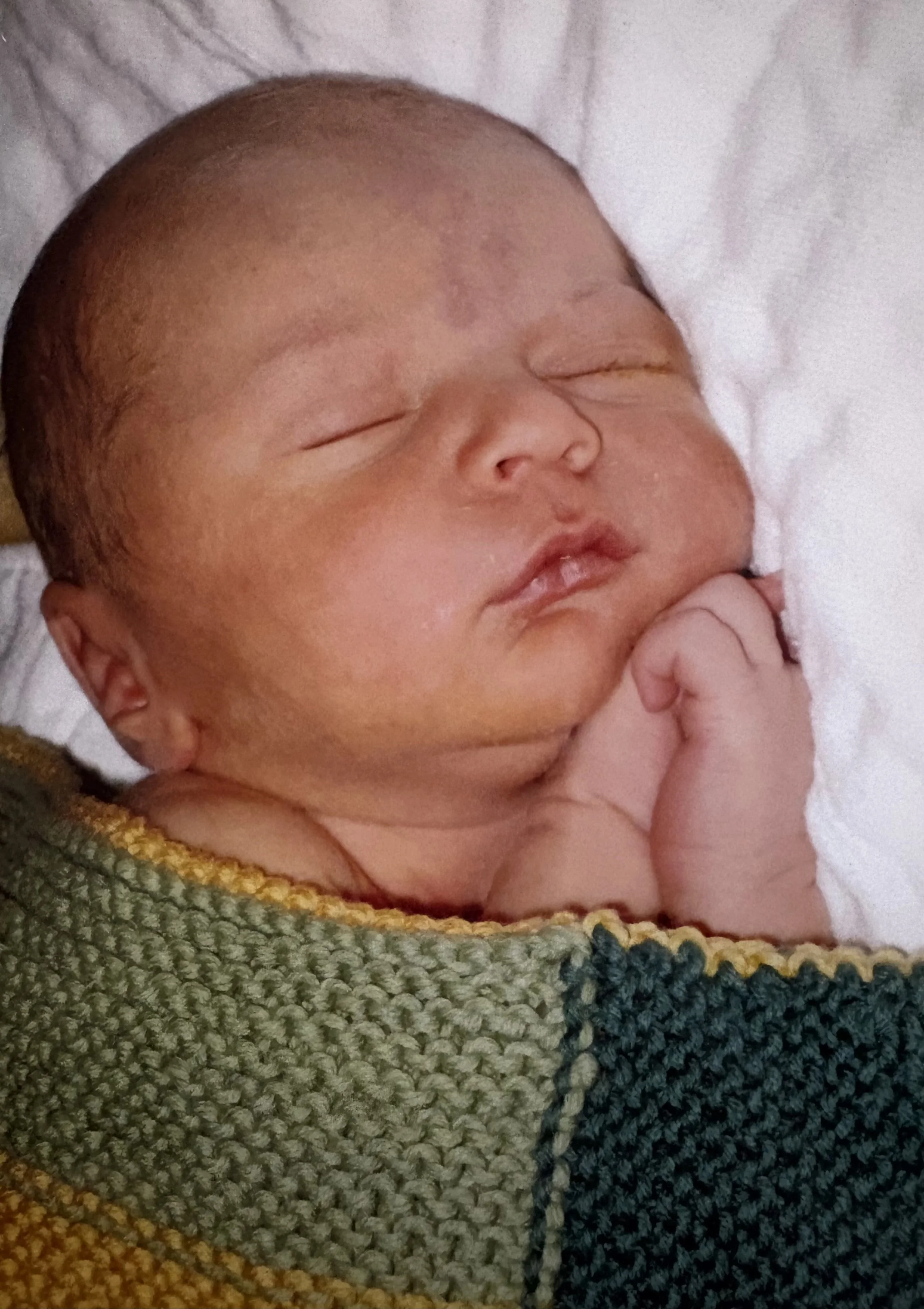
One of my son's first photos of him sleeping shows him wrapped in that blanket. The dark green stripe next to the cream stripe, edged in pale yellow, covers his tiny fist, squished up against his cheek.
I didn't knit that blanket one row per day on a consistent schedule. I knit it in surges. When the creative energy came, when the need to process surfaced, my hands arose, and I knit. And when it didn't, I didn't.
The blanket got finished. After his birth, I wrapped my son in something made with love during a time of massive transition.
Now here I am at another threshold. His leaving, my staying. Last week, I realized I'd been trying to force the same creative medicine into a productivity culture framework that doesn't make sense for how my brain actually works and what I actually believe.
This whole intersection of ADHD and midlife? It's messy as hell. But it's also generative in ways that productivity culture will never understand, mostly because it thinks humans should run like assembly lines.
What Keeps Us Stuck
We've swallowed productivity culture's definition of a "good" creative practice whole.
Show up every day.
Produce consistently.
Maintain steady output.
Build reliable routines.
The whole fantasy rests on this delusional assumption that your brain should work exactly the same on Monday as it does on Friday.
But ADHD brains don't work that way.
ADHD creativity runs on cycles of intensity. When something grabs your interest, your brain can hyperfocus for hours, producing work at a speed and depth that honestly seems superhuman. You're IN it. Time becomes irrelevant. You're channeling something.
When you're not in that state, even simple creative tasks feel like wading through wet cement in winter boots.
Long before I knew I had ADHD, I thought this was a lack of discipline on my part. It’s not. It’s just how dopamine-driven attention works. Your ADHD brain is constantly hunting for stimulation, novelty, and interest. When it finds something compelling, it floods you with hyperfocus, like a neurological jackpot. When it doesn't, no amount of willpower, positive affirmations, or bullet journaling can force engagement.
Now add midlife into this already chaotic mix.
You're navigating identity shifts, life transitions, changing roles, and existential questions about meaning and purpose that hit you at 3 am or in the middle of the grocery store. Some days you wake up with decent focus and creative energy. Other days, just heating the tea water feels like an achievement worthy of a trophy.
Here's the real trap, the thing that actually keeps creative women imprisoned: we've been taught that making time for creativity is selfish and indulgent; that everyone and everything else comes first; that we need to earn creative time by finishing all our obligations.
Which, let's be honest, are never finished.
So we wait.
We wait for "enough time" that will magically appear someday. We tell ourselves we'll start that painting class when life calms down (lol), when the kids are older, when work isn't so demanding, when we've somehow caught up on the infinite to-do list that regenerates faster than that annoying new chin hair.
Meanwhile, the creative life stays trapped inside. A whole universe of ideas with no outlet. A deep, aching need for expression with zero permission to prioritize it. And underneath it all, a paralyzing fear. If I let myself start, I'll get swept up in hyperfocus and neglect everything I'm supposed to be doing. Better not to start at all.
You know what that is? That's internalized productivity culture bullshit doing exactly what it's designed to do: keeping you small, keeping you "productive" for everyone else, keeping you from the very thing that might actually sustain you.
The problem is that we're trying to force a cyclical creative practice onto a linear system, while simultaneously treating creativity as a luxury we haven't earned, rather than the necessary fuel it actually is.
Creative practice is exactly the medicine women need in mid-life, especially those of us with ADHD brains.
Why Productivity Culture Can Go Kick Rocks
Consistency! Discipline! Goals!
Productivity culture sounds reasonable, if not exciting and rewarding. But when you're a neurodivergent woman in midlife trying to navigate both ADHD and massive life transitions, those rules don't just fail. They actively harm.
Without creative time to be in flow, to experiment, to practice pivoting and exploring, burnout arrives so much faster. When we treat creativity as the thing we'll get to "someday," we're eliminating one of our most powerful tools for staying resilient through everything else.
Think about it. Where else in your life do you get to practice flexibility? To try something, have it not work, and pivot without consequences? To be fully present in the moment instead of thinking seventeen steps ahead? To make mistakes that are actually interesting instead of catastrophic?
Creative practice gives you access to flow states that restore you. It reconnects you to your authentic self beneath all the roles you play: mother, employee, partner, daughter, friend, the person who remembers everyone's birthdays and keeps the household running.
But productivity culture has convinced us that making a product is what matters when it comes to being creative. You gotta have something to show for your time.
That's just self-optimization wearing a mustache and baseball hat.
And the disguise will burn you out as fast as any other hustle.
I know this because I'm living it right now through the quilt I planned to make for my son during his last year of high school. One embroidered square per day for a whole year. The rhythm of simple stitches on repeat, creating space for my mind to process my son's launch and my own transformation into whatever comes after "mother of a child who lives in my house." But I realize now that "one per day" is a productivity culture framework. It's not how I actually create. It's not how I knit that baby blanket eighteen years ago. It's not how my brain works.
The idea was right. The intention was beautiful.
The execution plan was bullshit.
Your Creative Energy Is Surge-Based
Your creative energy doesn't flow steadily. It moves in seasons.
I know this because I watch it happen outside my office window every year. There's a maple tree out there, and it's taught me more about creative rhythm than any productivity book ever could.
In spring, that tree explodes. It's not gradual or polite about it. One week it's bare branches, and then suddenly—almost violently—it bursts into flower and then leaf. The whole thing is a messy and wild explosion. Powdery yellow buds everywhere. Pollen coats everything. Then comes the shower of tender chartreuse helicopter seeds, followed by more robust seedlings that litter the sidewalk and root into the damp lawn. The tree is doing something with an intensity that feels almost reckless.
And then? It settles. The leaves fill out and the tree provides steady, reliable shade all summer long. It's beautiful and present, but it's not doing anything. It's just being. Holding space. Photosynthesizing quietly while the world happens underneath it.
Come fall, it lets go. The leaves turn, drop, and make a mess all over my driveway. And then the tree goes quiet for winter. Bare. Resting. Looking completely dormant to anyone who doesn't understand that this is when the root work happens. This is when next spring's explosion is being prepared underground, out of sight.
You can't force a tree to flower in December. You can't shame it into keeping its leaves through January. You can't make it produce steadily year-round just because that would be more convenient for your landscaping plans.
The tree has a rhythm. And if you try to fight that rhythm, you don't get a more productive tree. You just get a dead one.
Your ADHD brain, dopamine-driven creative practice works the same way.
There's the ‘spring’ surge when you're making connections at lightning speed, when time disappears, and you produce more in a weekend than you have in months. This is when the work pours out of you with an intensity that feels imprudent, wild, and irresponsible.
Then there's the ‘summer’ steady engagement with your creative work, but it's quieter. You're showing up, maintaining, maybe refining what you created during the surge. You're not exploding with new work, but you're present.
‘Fall’ is the letting go—when the creative project is finished (or finished enough), when you need to release it and move on. When you need to stop tending it and let it be what it is. This can feel like a loss, but it's necessary.
And ‘winter’ is the restful, dormant period when it looks like nothing is happening. When you're not actively creating, when your supplies sit untouched, when you can't even think about starting something new without feeling exhausted. What looks like (and sometimes feels like) creative death is the next surge preparing itself.
You can't make a tree productive year-round. And you can't make your ADHD brain creatively productive year-round either.
Let me offer a reframe.
Instead of trying to be consistently productive (impossible), become seasonally attuned (actually doable).
This means recognizing when your creative spring is building and clearing space to let it explode. Riding the surge as long as it lasts without drowning in guilt about other responsibilities. Honoring your summer as maintenance time, your fall as release time, and your winter as restoration time.
My maple tree doesn't apologize for going dormant in winter. It doesn't feel guilty about the mess it makes in the fall. It doesn't try to flower more slowly or consistently to be more convenient.
It just follows its rhythm. And every spring, it explodes again, right on its schedule.
When I knit that baby blanket, I didn't force myself to knit one row per day. I knit in surges, sometimes hours at a time, sometimes days between picking it up.
Now I need to give myself the same permission with these embroidered quilt squares. The quilt will get made. Probably not in time for his departure to college, as originally planned. But it will get made, because the creative medicine I need right now is the process of stitching while I process this threshold, not the achievement of perfect daily consistency.
You can do the same - on your schedule.
Design Your Creative Flow
Stop planning creative projects based on "I'll work on this 30 minutes every day."
Just stop. That's a neurotypical fantasy, and it's making you (and me) miserable.
Design a creative practice that works with surges instead of against them.
This isn't about forcing consistency. It's about becoming highly attuned to your rhythmic creative patterns, giving yourself actual permission to prioritize creative self-care, and structuring your practice to maximize the surges when they come.
Track Your Creative Surges
For the next 30 days, take some time to just notice your rhythm.
When do you feel creative energy building? (Time of day, conditions in your life, emotional states, moon phase if you're into that)
What are the early warning signs? (Restlessness, idea connections, the urge to organize supplies)
How long do surges typically last? (Two hours? Two days? A week?)
What follows a surge? (Exhaustion? Brain fog? How long before the next one builds?)
You're tracking to understand your rhythm so you can work with it instead of constantly fighting it.
Create a Surge Protocol
Once you start seeing patterns, develop a loose plan for when you feel a surge building. You need guardrails, such as timeframes, but they have to be flexible enough to support exploration and experimentation. Consider:
What can you clear from your schedule to protect creative time? (Even two hours matters. Even one hour matters.)
What supplies or materials do you need to have ready so you're not spending the first 45 minutes hunting for the right brush?
What's the lowest-stakes way you can enter the work? (Sometimes just starting is the hardest part.)
For my quilt project, I keep that clear plastic box ready to go. I don't have to think about gathering supplies. When the surge comes, I pick a pattern from the book, grab a blank square, and start stitching. The barrier to entry is as low as I can make it.
Pay attention to what you need to support the creative surge. I need simple food options, a good playlist, and space to spread out. I say ‘no’ more than ‘yes’ to social plans and usually exercise less.
There's no single right answer here. Some women need the container of "I'm setting a timer for two hours, and then I stop" because otherwise the guilt about obligations can become paralyzing and ruin the whole thing. Other women need permission to ride the wave until it naturally ends, and they build flexibility into their responsibilities to allow for that.
The key is figuring out what kind of container works for you. Not your neurotypical sister. Not the productivity influencer on Instagram. You.
After the surge settles and you’re ready to move on to something else, consider what will help you transition. Some journaling about your process, sharing with another creative buddy, taking a walk to integrate your experience into your body?
Between surges, do the low-cognitive-demand work: organizing supplies, researching inspiration, updating your website, responding to emails. Save the high-demand creative work for when you have the actual neurological capacity to do it.
Now, please know that even though I’m writing this article as if I were the expert, I don't do this well. I throw internal tantrums, sometimes I feel depressed for a day or two, and I get caught in the judgey self-talk. I’m right there with you, staring at a kitchen full of dishes, bemoaning the fact that I shoved off responsibilities.
Practice Gratitude Instead of Guilt
Guilt will show up. You'll get swept up in a creative surge, and the laundry won't get done. You'll be late responding to an email. You'll serve granola for dinner because you were deep in hyperfocus and lost track of time, and honestly, granola is a perfectly acceptable dinner.
The best antidote I've found to guilt is gratitude.
Thank the muse for showing up. Thank your brain for the hyperfocus. Thank yourself for honoring the creative need instead of pushing it aside again. Thank the surge for coming, for choosing you, for filling you up in a way that nothing else quite can.
When you frame creative time as necessary fuel for everything else you do, not as time stolen from your "real" responsibilities, the guilt starts to lose its grip. You begin to see that the two hours you spent painting actually make you more present with your kids afterward. The morning you spent writing makes you more focused at work. Your creative practice is sustaining your capacity to meet your obligations.
Every time I stitch a blue linen quilt square, I'm practicing being present with this transition instead of numbing out or staying busy to avoid feeling it. That makes me a better mom to my son during his senior year. More available. More grounded. Less frantic about controlling things I can't control.
The creative practice isn't taking me away from parenting. It's helping me show up for it more fully.
Reframe the Dormant Periods
The dormant periods are part of the creative cycle.
Soil needs to rest between plantings; otherwise, it becomes depleted, and nothing will grow. Your creative capacity works the same way. It needs restoration between surges.
During these dormant times, read books that inspire you. Visit museums or galleries. Take walks and actually notice the world instead of thinking about your to-do list. Organize your creative space (this counts as creative time). Let your unconscious mind work on problems while you do something totally unrelated. Rest without guilt (this is the hardest one and also the most important). Tend to the other parts of your life that need attention.
The weeks I don't touch the box of quilt supplies are the weeks I'm living my life, spending time with my son, working, processing in other ways. The creative practice doesn't have to be constant to be valuable. It just has to be there when I need it.
Catch the Midlife Transformation Wave
The chaos and dissolution of midlife - empty nesting, divorce, changing jobs or retirement, perimenopause and hormonal shifts, etc. - can be creative fuel.
These life transitions break down old identities, old certainties, old ways of being. It's disorienting and uncomfortable as hell.
But creatively, that dissolution is gold.
Some of the most powerful art emerges from liminal spaces, those in-between times when one thing is ending and another hasn't begun yet. When you're questioning everything. When the old masks of identities are falling away, and you don't know who you're becoming yet.
Your midlife experience, the identity shifts, the questions about meaning, the reckoning with time and mortality, the changing relationships, the way grief and possibility can exist simultaneously, this is material. It's truth. It's the raw stuff of authentic creative work.
What if you channeled this experience into your art (and when I say art, I mean painting, gardening, writing, learning something new, redecorating your home, etc.)? What if you let your creative practice be the place where you actually process this transition instead of pretending you're fine? What if the confusion and dissolution became the subject instead of something you had to overcome before you could create?
Some of my most honest, powerful work has come from this intersection.
When I was pregnant eighteen years ago, I knit tiny sweaters and socks while processing the terror and excitement of becoming a mother. The creative practice gave me something to do with my hands while my mind worked through what was coming.
Now I'm on the other side of that threshold. My son is leaving. I'm becoming something different: a mother to an adult who lives elsewhere, rather than to a child who lives in my house. I don't know who I am on the other side of this yet.
But I know how to stitch. I know how to keep my hands busy while my mind wanders through the feelings. I know how to prepare.
Embroidering the quilt blocks is doing the same work the baby blanket did: creating space for me to be with what's coming and to process the transition through repetitive, meditative handwork.
The process is the medicine. Medicine that prevents burnout. Medicine that teaches you and me how to pivot and explore and stay flexible in a world that demands rigidity. Medicine that reconnects us to who we are underneath all the roles, responsibilities, and expectations. The product, if there is one, is simply evidence of the process.
Stop Waiting for Permission
You're standing on extraordinarily fertile ground.
Your ADHD brain gives you access to hyperfocus surges that can produce work of incredible depth and intensity when you stop fighting them and start riding them. Your midlife transition is cracking you open to truths you might have been too comfortable or too busy to explore before.
These forces are the architecture of a completely different kind of creative life, one that's more honest, more powerful, and more aligned with who you actually are instead of who you think you should be.
Your most powerful creative work isn't behind you. It's building right now, in the space between who you were and who you're becoming.
That baby blanket got finished in spurts, and my son was wrapped in it for years. The quilt will get finished the same way. And both will have done their real work long before they were completed: giving me a way to be present with love and fear and transformation, one stitch at a time.
xo,
Maggie
PS…